Kubrick directs a darkly comic paranoid farce about humanity’s impending nuclear annihilation at the hands of military bureaucracy.
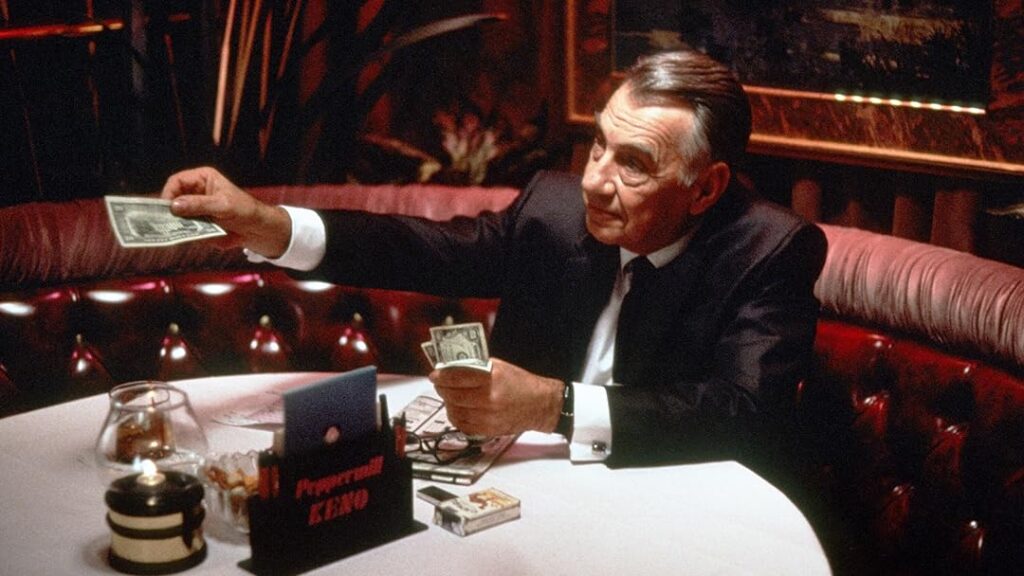
— Colonel… that Coca-Cola machine. I want you to shoot the lock off it. There may be some change in there.
— That’s private property.
— Colonel! Can you possibly imagine what is going to happen to you, your frame, outlook, way of life, and everything, when they learn that you have obstructed a telephone call to the President of the United States? Can you imagine? Shoot it off! Shoot! With a gun! That’s what the bullets are for, you twit!
— Okay. I’m gonna get your money for ya. But if you don’t get the President of the United States on that phone, you know what’s gonna happen to you?
— What?
— You’re gonna have to answer to the Coca-Cola company.
It was a scary world if you were a citizen of either global superpower during the Cold War. As international unease heightened, the fear of nuclear conflict between the US and USSR thrived as well, keeping the populations of both nations in a static state of anxiety where their only political worries were defined by a vilification of ‘the other side’. Though this may seem like stating the obvious (which it is), that context is vital to understanding the satire of Dr. Strangelove, a self-contained lampoon of nuclear war planning and the escalation of military conflict told from every perspective involved. In just 95 minutes, Kubrick compacts every fear, attitude and opinion of the Cold War into one darkly satisfying military comedy, all while the tension broadens still more around him.
For an audacious and genuinely funny satire aimed at a target of such scale to come together so well is truly a profound feat, and you can tell they knew it too; every forceful back-and-forth is punctuated with equally unstable camera movements and cuts, every performance evokes a unique energy that likely should not be present when dealing with war, and every plot beat introduces itself as though it’s immensely significant before its implications fizzle out into relative obscurity. The very storytelling of the film reflects the same emotions as the public understanding of politics, constantly determined by conspiracy rather than reason, or pre-existing ideology rather than analytical thinking.
A monologue that signifies the film’s inciting incident illustrates this theme perfectly. Ripper’s attempt to justify his radical action before the film’s satire begins to accelerate creates quite the powerful portraiture of a true militarist fanatic; the conviction of every word demonstrates plainly that this is a man so thoroughly invested in the exceptionalism of his glorious, God-gifted America that he is willing to take atrocious measures to override political authority and protect his precious bodily fluids from Communist infection. His devout belief in these reality-divorced political notions become all the more terrifying once you recall there are those who believe the very same.
Kubrick offers a perspective in which discussions on imminent planetary extinction are treated with the same careless brutishness as domestic arguments, where the decisions of major government leaders are guided either by partisan lunacy or uninformed passivity; a satirical angle whose brilliance is revealed at the realization that it’s not all that far off from real-life politics, both in the film’s day and in the current age. As a provocative farce designed to further agitate the fears of an already on-edge American public, it succeeds with flying colours, and as a stinging criticism of the fragile, imperfectly fashioned military systems and philosophies of the Cold War, it succeeds just as much.
As far as the comedy itself goes, its excellence can be found long before exploring its layered meanings, as it connects with the viewer on the simple, immediate level of joke-to-laughter. The sincere hilarity of each comedically focused moment can’t be justified with a description alone, nor even by directly quoting the dialogue itself, simply due to its origins in expert line delivery (something not unique to this movie of course, but a fact that cannot be ignored when talking about audible and/or visual comedy). It’s best explained by citing how it’s a black comedy with a sense of humour so dark, it was originally developed as a drama before Kubrick found himself unable to ignore the inherent humour of the situation. If a disorganized, internally conflicted government’s frantic attempts to prevent a third world war sound opportune for jokes that align with your comedic taste, it’s unlikely you will be disappointed by what this movie has to offer.
The dedication behind many of the performances should not be understated either; whether it be the facial dynamism undertaken by George C. Scott’s ragefully enthusiastic Buck Turgidson, the overpoweringly deep Southern tonality of Sterling Hayden’s wildly dogmatic Jack Ripper, or the all-American fervor of Slim Pickens’ virtuous T. J. Kong, the leaps and bounds each actor takes to outshine their co-stars produce fully unique, theatrically invigorating characters to acquaint the satire with. Ensemble casts often provide such an effect, but this functions well as a paradigm for the inevitability of actors’ consistent attempts to outperform those they’re in company with.
But of course, the one that truly outshines them all is the great Peter Sellers, and not only because he’s given three times the opportunity. Sellers externalizes every performative fibre within his soul in order to embody the natures of his multiple roles, invoking their distinct eccentricities and idiosyncrasies with flawlessly natural emotion (and, more relevantly, physical comedy). As President Merkin Muffley, he can depress himself into the serious, uncharismatic Democratic politician known to all Americans, as Lionel Mandrake (the only one truly in a haste to prevent the decimation of humankind), he can politically correct himself into an upright (but disingenuous), stiff upper lip Englishman, and as Dr. Strangelove himself, he exaggerates to such a degree of erraticism, he practically reinvents the mad scientist archetype (while simultaneously giving it an impulsive Nazi twist). With his sincere conviction, he elevates each of these characters to far more than bit parts; in fact, he makes them so funny that not even his fellow cast members can keep themselves from laughing (the Russian Ambassador can be seen struggling near the end of the film).
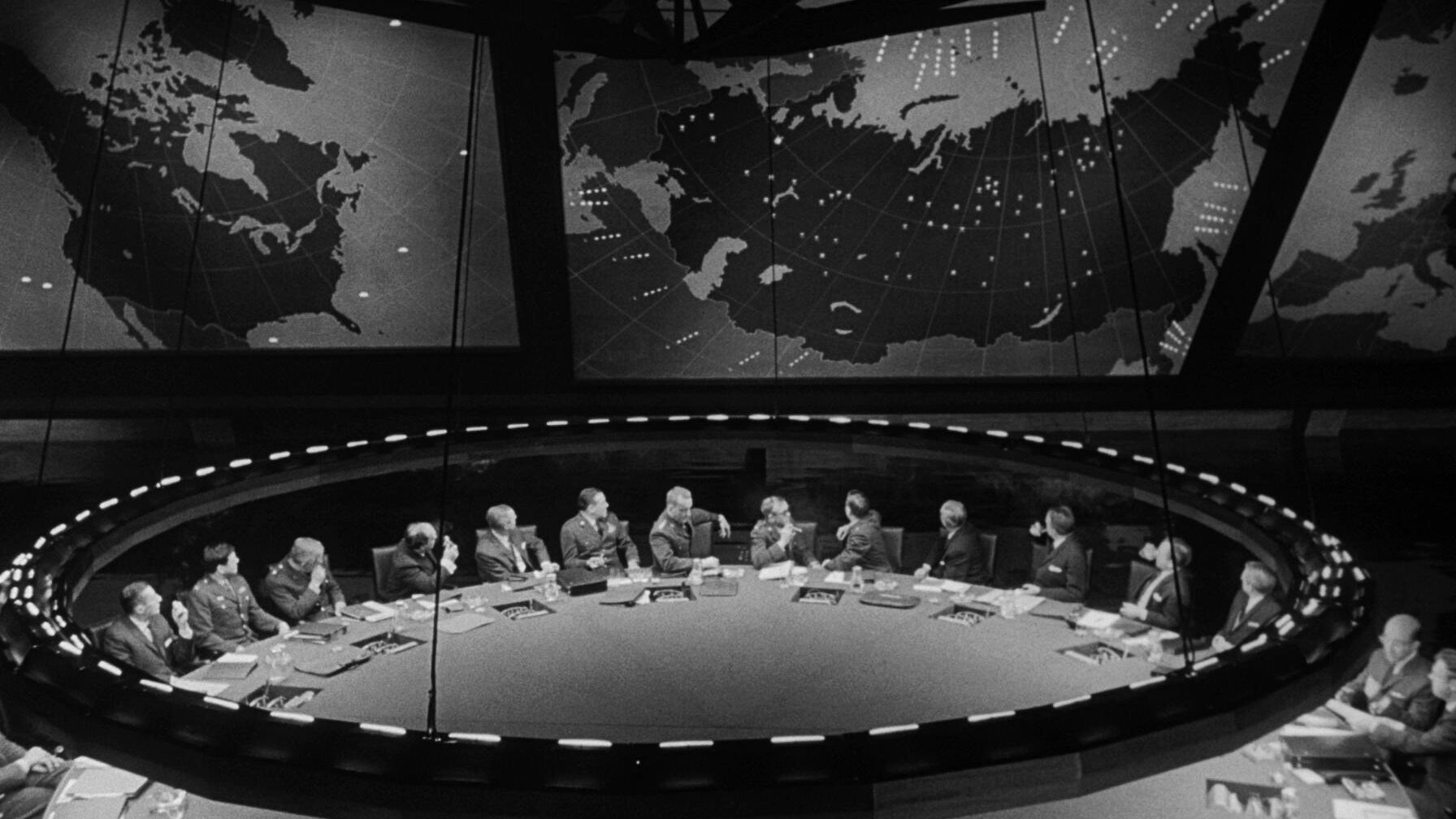
Though praise for those in the limelight is where the mind is drawn, it shouldn’t be forgotten where Sellers’ great bouts of acting need to be grounded, or where Kubrick’s poetic shot composition must be located; Dr. Strangelove‘s production design is arguably one of its strongest elements, to the point where it may just be the most iconic part of its legacy. For instance, the main setting of the film, the Pentagon’s war room (“Gentlemen, you can’t fight in here!”), a disproportionately vast bomb shelter of a council chamber whose impractical distortions contribute so completely to the feeling of unreliability that pervades the screenplay, it becomes nearly unnoticeable as the audience is subjugated to its subjective outlook. During production, Kubrick even demanded that the round table be covered in the green baize of poker tables to immerse the actors in the idea that they were gambling on the fate of countless human lives. The film’s settings are equally clever as its jokes, and easily twice as effortful.
Obviously, none such inventiveness would be possible without Kubrick’s uniquely sly directorial style; his craftiness in ensuring his colleagues conformed to what he wanted, though not at the damaging levels of his later work, comes across as the beginnings of his distinctly uncollaborative auteurism. Famously, he tricked George C. Scott into giving his outrageous performance by convincing him to do some over-the-top takes as practice for more controlled ones later on; in the end, those later takes were never used, and the ridiculous version of the character that Scott had not been comfortable performing is what made the final cut.
Nobody who’s seen the film could deny that the hamminess of Scott’s character works wonders, but is the value of its hilarity greater than that of its expense? One could argue that Kubrick is justified in scheming this way due to the superiority of his creative decisions, and it should certainly be understood that a director deserves to have the highest authority on a project, but should he be allowed so much control as to deny the innately synergetic nature of film? For that, I don’t have an answer, but I can guarantee it’s tainted his legacy with just as much controversy as praise, and irreparably cemented his name into the list of obsessively creative perfectionists. Whether that’s a good or bad thing, I can’t say either, but it certainly is ironic considering the dooming infallibility of machines criticized so extensively here. Life imitating art, perhaps?