Armed with an almost monochromatic flame colour palette and the dulcet tones of Kurt Cobain, Matt Reeves’ take on a despondent Gotham is a rousing spectacle.
When The Batman starts off with the subtle opening melodies of “Ave Maria” overtop an enormous title banner coloured in blood red, no definite stage is set, but rather, one shrouded in a mysterious fog, invoking uncertainty within the audience as to what the next three hours of their life are going to look like and establishing the enigmatic chaos that will ensue in Reeves’ neo-noir. Unpredictability, even when the riddle appears spelled out, plagues the bleary air of Gotham, where violence prowls the shadows no matter its form or scale, and the city’s people are so morose that they seem to will dense rainfall into taking place each and every night. And while it may be a hopeless endeavour to create a dark and mature crime drama out of a story where the main character is called ‘the Batman’, Reeves pulls off getting it about as close as you could possibly get.
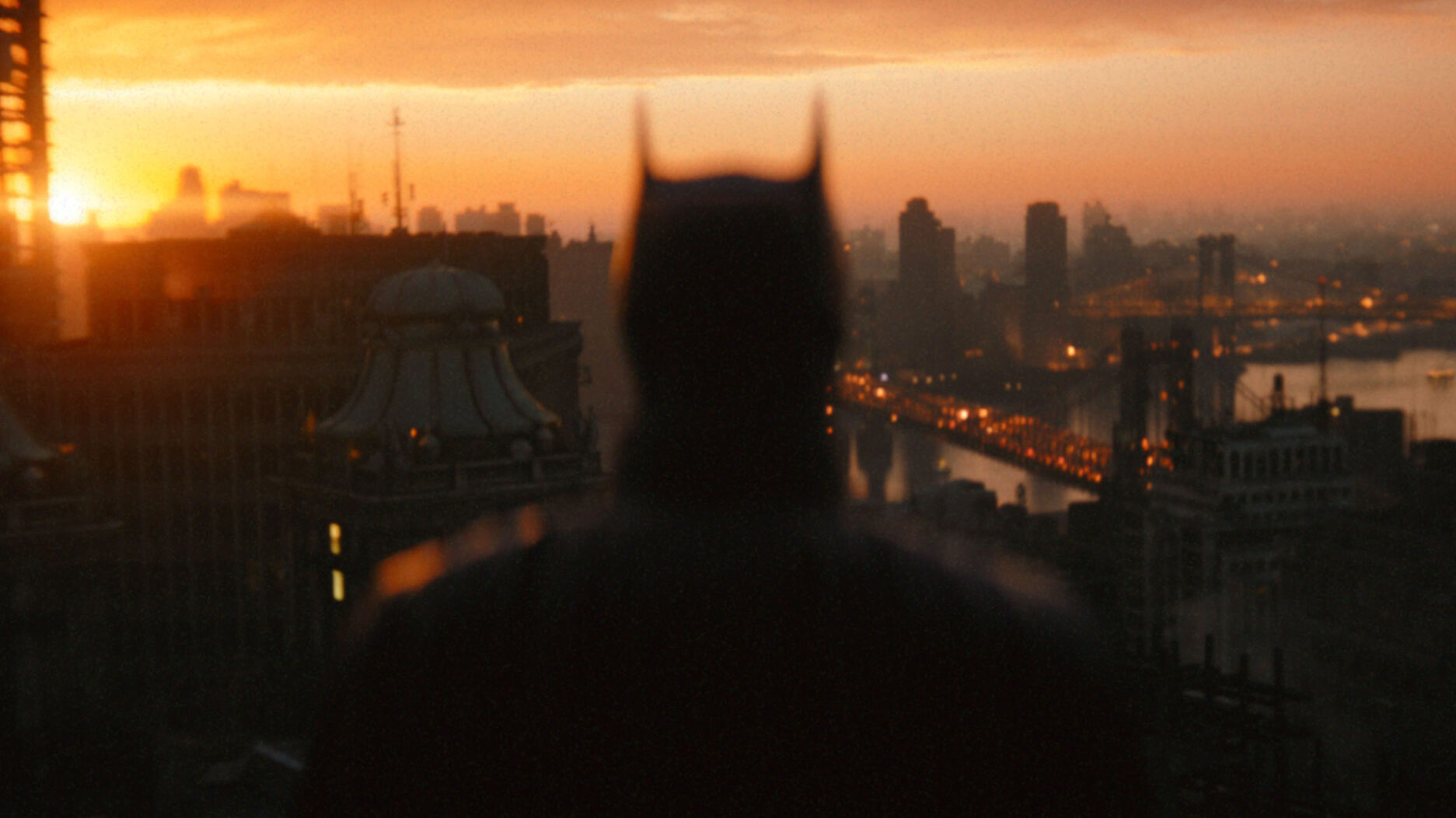
Reeves manufactures an aesthetic so stylized in its obscuring of realism, it appears era-defying even in the presence of advanced cybernated gadgets and smartphones, employing silhouette, Kuleshov, and roving camera movement to communicate the blackened intensity of its cutthroat assaults and constant, inevitable cruelty. At both our introduction to and parting of this city, we watch it existing simultaneously as a police state cracking down on the pettiest of crime through the symbolic power of the Batman, and the haven for a hierarchical crime syndicate of concealed political relations and tight, tyrannical control; both are pounding structures of oppression that our hero never fully understands, but in the case of the latter, will relentlessly oppose.
Carmine Falcone, possessed menacingly by the less than dashing John Turturro, is at the head of every operation in town, accompanied by an unrecognizable Colin Farrell as his aide-de-camp, the Penguin (eventually humiliated into actually waddling as a penalty for his royal depravity), but they both play second fiddle to Paul Dano’s Riddler, equal parts radical anarchist and TikTok influencer, who exhibits the omnipotence of Se7en‘s John Doe and the pathetic narcissism of his own Eli Sunday. In the central dichotomy of the narrative, he presents the drastically adverse view to that of the lead, challenging his moral imperatives by offering absolute lawlessness in return. Gradually, as the plot crescendoes, we are demonstrated how both their ideologies fail, the Batman, his fascism, the Riddler, his libertarianism.
When the interests of a quietly affiliating ruling class (politicians, organized crime, private corporations) are necessarily contrary to those of the people, the Riddler simply can’t accept it; his response is to call for revolution by exposing every facet of the rampant institutional corruption that has silently infected the city, applying the same showy methods as Heath Ledger’s Joker did in The Dark Knight, but only with his own cleverness, absent of Ledger’s bountiful resources and scores of unvalued followers. But his revolution is individual, and its image sinister (not to mention its cause beyond unmasking the discreet fraud involves total dissolution of any and all systems of social order, preferring the disorder of anarchy), so it can’t spark the city-wide revolt he would like, creating only the fear that law enforcement already wields so tightly for social control; it’s a discretionary rebellion he’s tried to launch, one that he’s decided himself should start here and now while the vast public isn’t quite ready.
In contrast, Bruce Wayne is mostly naive in the imposition of his beliefs. He’s a Batman who believes in the meritocratic lie of individual choice guiding fate, who only ever fights crime when it’s tangible and distinctive, and who can only solve mysteries when there are clues intentionally laid out for him, ones that come in the form of puzzles, at that. In his isolating wealth (as Catwoman, portrayed graciously by Zoë Kravitz, so perceptively points out), he’s been deluded in his understanding of what defines the world, believing it only to be a realm of individuals where some do bad and others do good, where their destinies are determined by their own election. ‘Systemic’ isn’t a word in his vocabulary, and he is fully trusting of the renderings of criminality outlined by the immovable foundations of the justice system, choosing to uphold their arbitrary rationality with his classic, gadget-handling, detective-mimicking comic vigilantism.
But it’s his lack of recognition of society that brings about his continuous failure to affect crime on a city-wide scale; he believes criminals are simply an inevitable group of deviants that will always consume the shadows of an otherwise well-balanced public, a force that needs to be corrected whose commonness comes down only to the ineffectuality of police processes. How telling it is that the politician who campaigns for the kind of city he supports argues for cracking down more severely on illicit acts in response to their rising prevalence, rather than improving the social conditions of those who perform them. His protection of these systems, these dogmatic parameters on what constitutes level-headed, good change sees him ultimately failing to make Gotham a truly better place; only strengthening his worldview of a firmly cemented societal arrangement where individual action is the only determining feature of any kind of motion.
These clashing values and belief systems are also what give The Batman‘s action set-pieces their character, granting residence to car chases that cut in close quarters with their drivers, dark hallway fights that illuminate the metallic exterior of the Dark Knight with the rapid fire of faceless henchmen, and instant pummels that batter with the same force as San’s blade swipes in Princess Mononoke. Every sequence of heart-racing thriller energy has real cinematic dynamism to it, connecting to the subjects of the violence by understanding that it isn’t just violence, but physical debates between human beings; agitations of their emotions, their fears, and most obviously, their hatred. Malice, rage, or vengeance guides the horrific acts of each colliding faction, collective good forgotten in their selfish blaze of brutality.
Without the shackles of studio sameness or derivative visual design, weighty art direction pounds the screen with its immediacy, adjoining the artistic methodologies of brooding film noir cynicism and kinetic, quick-cutting blockbuster vitality for a style unlike any other film of its type. With the ghostly haziness of the world that has been constructed, we feel how miserable the environment we’re being placed in front of truly is, how its strenuous layout, which is itself lost to us in a sea of close-ups and mediums, annoys and confuses in tedious urban banality and concrete destitution. Although I may have preferred a greater constancy of blood red lighting in place of the mercury yellow and radiant orange, such colours work wonders for the film’s portraits as well, summoning the enviable magic of vivid photography in what is already astonishing cinematography.
Even then, when it’s saturated with character and a fitting detachment, Reeves’ and Fraser’s stunning manipulation of the camera is eclipsed by an unassailably vicious score from Hollywood’s musical genius, Michael Giacchino; the screeches of his shrill violins spiral at points of world-overturning discovery and abject horror, his impassioned piano playing shades the tragedy of every scene, and children’s choirs give a suspenseful tone to the already electrifying sequences of hair-raising mystery and creepy ambience. His orchestra creates an overwhelming soundscape for some perfectly crafted mood, cementing his dexterity in designing intricately unique melodies for the films he composes, and making for wonderful ear candy after leaving the theatre.
There’s one thing that potent cinematic atmosphere can’t overturn, no matter its ferocious rawness or outward maturity; silliness. There’s something very goofy about the Riddler drawing question marks in his latté, about Gotham happening to be located in a valley surrounded entirely by water, or the idea of buying the domain for rataalada.com for your plan to serially murder every shady government employee in town. It exists out of place in a film that likes to maintain complete earnestness, souring the resonance that it otherwise captures so well by engaging in Adam West-level absurdity. Even the Riddler’s plan by the end; to suddenly swap from creatively exposing the lack of ethics in concealed political associations to attempting to massacre an entire city seems out of character for an anarchist no matter how much he hates society. Such an immediate change has an air of cheapness, of a kind that couldn’t be further away in the film’s other contexts.
Regardless, The Batman is a far cry from the weaker ventures in Hollywood cinema. It’s somewhat relieving to enjoy a blockbuster that can be genuinely creative with how it presents itself, that can, even without ironing out a definite conclusion, make political commentary without the subtly propagandizing condescension of the more imperialist superhero works seen today, that can, even while failing to fully combat the innate absurdity, create a story with real grittiness and murk; a feat that Warner Bros.’ past efforts with Snyder and the like have tried to perform, and miserably, miserably failed. So, you might as well come along to see the Bat play out his fascist bloodshed, enjoying morbidly, against your better nature, his dictation of responsibility upon each individual for their transgression of the existing laws, and laughing, for its antithetical ridiculousness, when Pattinson spray paints “THE SINS OF MY FATHER??” on the floor as though it could actually help with his investigation.