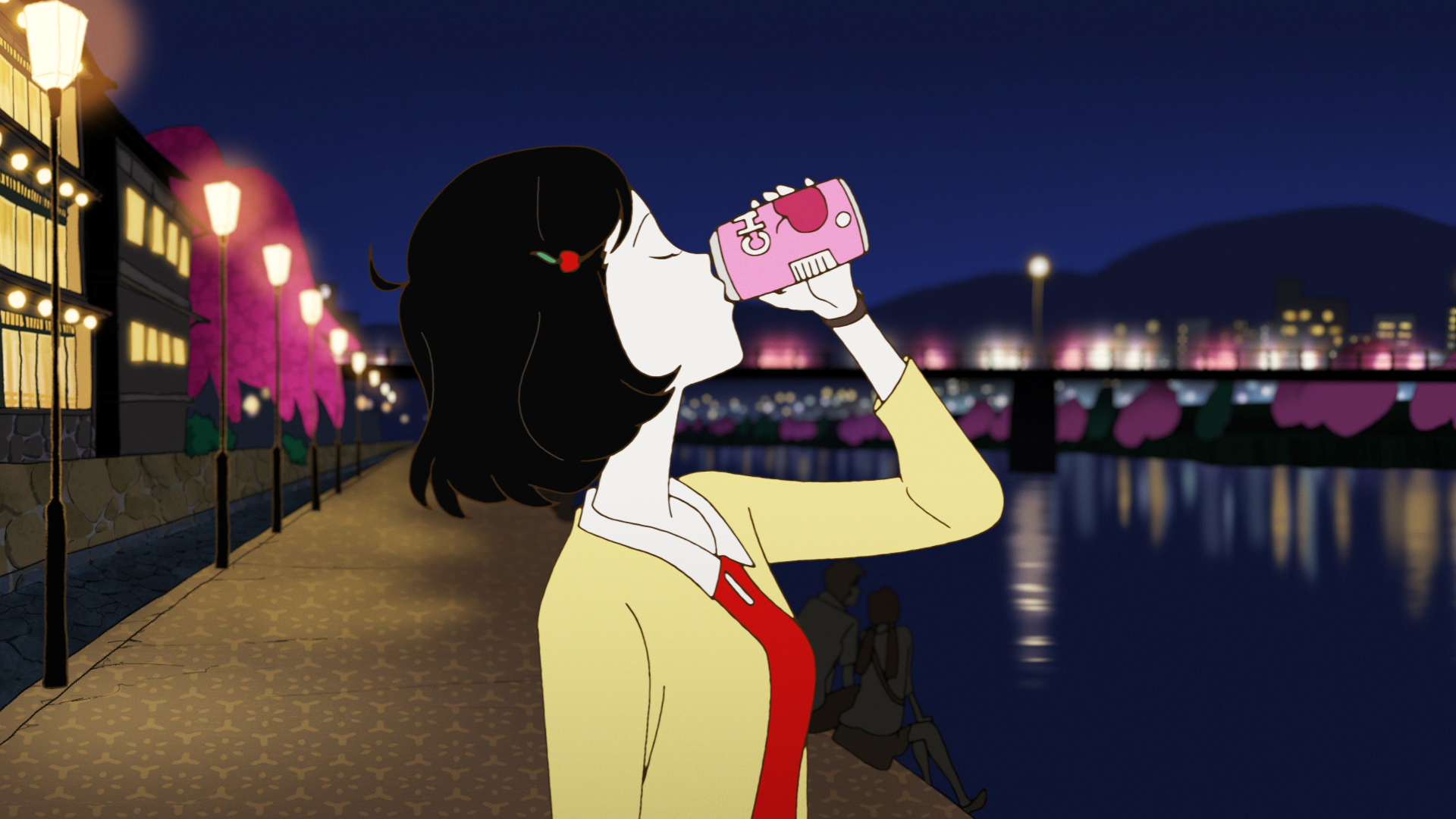
Plot synopsis has never been more irrelevant than with Masaaki Yuasa’s colours-and-shapes masterpiece.
We were done in by the God of Old Books. That’s annoying as shit.
For what is determinedly a movie based around randomness, a manic waltz through the streets of a town without internal consistency, rationality, or logic, Night is Short, Walk On Girl constructs itself to be surprisingly intricate; it creates perfect expository set-ups hours before they’re reincorporated for bonkers pay-offs, subtly alluding to things before they’re expanded to major plot elements, contorting the ordinary into the surreal with glorious ambition and maniacal excess. There is no event that is not essential to the core of the film, no matter how trivial it may seem at first, whether it be the internal parliamentary senate interrupted and unseated by an ocean of puppet cowboys, the twisty musical number where every verse further entangles and radically inverts the existing situation, or the mythic flu epidemic only spread so rapidly because of a fairytale wind, everything serves its own purpose in the hydraulic network that is the plot.
Yuasa makes far-reaching strokes of surrealism in every frame, leading hands to grow beyond their size in passionate monologues, guts to widen as enormous gulps of alcohol are drunk, and lips to inflate in response to the unimaginably volcanic heat of a steamed dish. It dances in every dutch angle, every wild metaphor, and every resident of his senselessly mobile city. They make their decisions based on the interchangeable guidance of logic and poetry, always resolutely determined to do what must be done in the interest of the needs of their constantly changing setting. Overstated caricatures stand alongside minimalist figures, moving viscously within both the bounds of realism and the borderless fields of exaggeration; the sleaze or kindness of any given character can be spotted immediately with their shape and body language, flawlessly handling animation’s nature of creating character out of simple movement and appearance.
What is far less striking about the film than its animation (and an utterly joyous score from Michiru Ōshima) is its themes, as strong as they can be in the context of the almost folkloric epic that is presented to us. Ultimately, it advocates for a kind of spontaneity that operates with the same energy as the film’s pacing itself, positing the failure of mental debate as it exists within oneself; it’s charming when confined to the individual level, and hopefully, merely the level of romantics as well, but once it extends to emboldening impulsive, competitive entrepreneurship, that charm is instantly lost as quick as it appeared (before thankfully reinstating itself by the endings; both the climactic, and the subtle). Yuasa even dedicates the resolution of one conflict to confirming the capitalist narrative, that being the existence and free activity of entrepreneurs is exclusively beneficial to the community, rather than constraining their freedom and exploiting environments both natural and industrial for their own exclusive liberty and rule.
But still, it hardly matters in the presence of such unadulterated beauty. As with The French Dispatch, the thinly veiled, bourgeois-favouring messaging can be ignored out of respect for what are genuinely impeccable formal qualities*; no film has moved me so profoundly based on visuals and comedy alone, and I cautiously doubt that one ever could. It is oceanic and psychotic in how captivating it is at all times, nonsense in the most cogent and genius of ways, and words (like most titans of cinema) don’t and could never do it justice. I can’t imagine how experiencing this in a theater would be anything other than dreamlike, and Yuasa’s Miyazaki-level talent cannot be rationalized in my mind. The two are both visionaries, and though one may have a more nuanced grasp on politics, I can’t help but see myself visiting and revisiting the former’s works for years to come, in appreciation for the fated conclusion that he will become one of my favourite filmmakers.
*The French Dispatch doesn’t quite have those in such wealth but regardless.

The article you just finished reading can also be found on Letterboxd.